

Under Section 11011 of Pub. L. 115-97, commonly known as the Tax Cuts and Jobs Act of 2017 (TCJA), Section 199A of the Internal Revenue Code introduced a deduction for qualified business income (QBI) from pass-through entities. This provision, allowing eligible taxpayers to deduct up to 20% of their qualified business income, is statutorily set to expire on December 31, 2025. The impending sunset heralds a fundamental shift in the tax landscape for millions of sole proprietorships, partnerships, and S corporations that form the backbone of the U.S. economy. As 2026 approaches, the absence of this significant deduction necessitates a proactive and rigorous re-evaluation of financial strategies, entity structures, and operational decisions for pass-through businesses. This analysis delves into the critical adjustments required to optimize taxable income and maintain financial viability in the post-QBI era.
The Genesis and Impact of Section 199A
Enacted to mitigate the disparity between the new 21% corporate tax rate and the higher individual income tax rates applicable to pass-through business owners, Section 199A aimed to stimulate investment and job creation within the non-corporate business sector. It allowed a deduction of up to 20% of QBI, subject to various limitations based on taxable income, W-2 wages paid by the business, and the unadjusted basis of qualified property. For many small to medium-sized businesses, this translated into a substantial reduction in effective tax rates, often bringing them closer to parity with C corporations. The deduction provided a significant incentive, particularly for businesses in service industries, though those classified as "specified service trades or businesses" (SSTBs) faced tighter income thresholds for eligibility.
The economic impact of Section 199A since its inception has been considerable. While difficult to isolate from other TCJA provisions, anecdotal evidence from tax preparers and financial advisors suggests a tangible benefit to pass-through entities, freeing up capital that might otherwise have been allocated to tax liabilities. Its existence likely influenced investment decisions, growth trajectories, and even the choice of entity structure for new businesses formed between 2018 and 2025. As the deduction’s expiration looms, businesses that have become accustomed to this significant tax relief must now recalibrate their financial models to account for higher future tax burdens, potentially impacting cash flow, expansion plans, and owner distributions.
Recalibrating for the Post-2025 Tax Environment
The immediate consequence of Section 199A's sunset is an increase in the effective tax rate for many pass-through business owners. For an individual in the top marginal income tax bracket, the loss of a 20% QBI deduction on a substantial portion of their business income could mean a significant jump in their tax liability. This shift demands a comprehensive re-forecasting of after-tax income and a critical assessment of current tax planning strategies. The assumption underpinning most forward-looking financial models for pass-through entities will transition from incorporating a 20% QBI reduction to reflecting full taxable income at ordinary individual rates.
Businesses must engage in scenario planning to understand the quantitative impact of this change. This involves projecting income, expenses, and capital expenditures for 2026 and beyond, first without the QBI deduction, and then comparing these projections to prior-year calculations. Such an exercise will highlight potential cash flow gaps, inform pricing strategies, and guide decisions regarding retained earnings versus owner distributions. Furthermore, the absence of Section 199A will likely amplify the benefits of other existing tax mitigation strategies, making their optimization more crucial than ever before. This includes a renewed focus on legitimate business expense deductions, strategic timing of income and expenses, and maximizing available retirement plan contributions.
Strategic Re-evaluation of Entity Structure
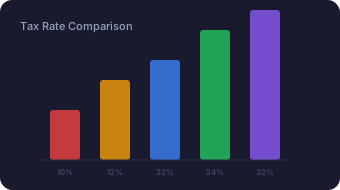
The expiration of Section 199A reignites the perennial debate over optimal entity structure, particularly the comparison between pass-through entities (S corporations, partnerships, LLCs taxed as such) and C corporations. During the TCJA era, the 20% QBI deduction often made pass-through structures more attractive for owners whose individual tax rates, even with the deduction, remained below the combined corporate and dividend tax burden of a C corporation. Post-2025, with a flat 21% corporate tax rate remaining, the calculation shifts dramatically.
For businesses with significant profits, especially those planning to reinvest earnings or defer distributions, the C corporation structure may become more appealing. A C corporation pays a flat 21% federal income tax on its profits, and shareholders are taxed again only when profits are distributed as dividends. Without Section 199A, a pass-through owner could face individual income tax rates as high as 37% (or higher, considering state taxes) on their entire business income. This differential could push many profitable pass-through entities to consider conversion, particularly if their owners are in high individual tax brackets and are not dependent on immediate, full profit distributions. However, the double taxation of C corporations remains a significant deterrent for businesses that routinely distribute most of their earnings.
Navigating the C-Corp Conversion Decision
Converting to a C corporation is not merely a tax calculation; it involves legal, operational, and administrative considerations. While the 21% federal corporate tax rate is attractive, potential double taxation on distributed earnings (corporate tax plus individual income tax on dividends) must be weighed carefully. Businesses with substantial growth plans and a need to retain earnings for reinvestment might find the C-corp structure more advantageous, as retained earnings are only subject to the corporate tax. Conversely, service businesses or those with owners who regularly withdraw most profits for personal use may find the double taxation prohibitive.
Considerations for conversion include:
- Income Level: Higher-income businesses are more likely to benefit from the lower corporate rate if they retain earnings.
- Distribution Philosophy: Businesses that distribute most profits will face the full brunt of double taxation.
- State Income Taxes: Many states have varying corporate and individual tax rates, which can significantly alter the federal analysis.
- Administrative Burden: C corporations often face more complex compliance requirements compared to S corporations or partnerships.
- Exit Strategy: The tax implications of selling a C corporation versus a pass-through entity differ significantly.
The decision must be highly individualized, involving detailed financial modeling that projects tax liabilities under both structures, accounting for potential qualified dividends tax rates and net investment income tax (NIIT).
Optimizing Deductions and Expense Management
With the QBI deduction no longer available to soften the tax blow, the meticulous optimization of legitimate business deductions will assume paramount importance. Every dollar of deductible expense directly reduces taxable income, leading to immediate tax savings at the owner's marginal rate. This requires a renewed emphasis on robust record-keeping, diligent expense tracking, and a comprehensive understanding of eligible deductions, moving beyond the casual approach some may have adopted while Section 199A provided a buffer.
Strategies for enhanced deduction optimization include:
- Maximizing Ordinary and Necessary Business Expenses: Scrutinizing all operational costs to ensure proper classification and documentation. This includes supplies, utilities, rent, advertising, professional fees, and travel.
- Depreciation and Amortization: Fully utilizing accelerated depreciation methods like bonus depreciation and Section 179 expensing for qualified asset purchases. While bonus depreciation is also slated to phase down and expire, its maximum utilization in the remaining years and strategic timing of asset acquisitions remain critical for immediate tax benefits. For example, under current law, 100% bonus depreciation phases down to 80% for property placed in service in 2023, 60% in 2024, 40% in 2025, and 20% in 2026, expiring in 2027. Careful planning here is crucial.
- Home Office Deduction: For eligible home-based businesses or those with hybrid models, ensuring the full utilization of the home office deduction, whether via the simplified method or actual expenses, based on IRS Pub 587 guidelines.
- Insurance Premiums: Deducting all business-related insurance premiums, including health, liability, property, and workers' compensation.
Strategic Compensation and Retirement Planning
For pass-through entities, particularly S corporations, the compensation structure for owner-employees takes on added significance. Without Section 199A, minimizing taxable income at the entity level becomes critical. This often involves maximizing deductible compensation and benefits. For S-corp owners, careful consideration of reasonable salary versus distributions is key, especially given the self-employment tax implications of guaranteed payments for partnerships.
Furthermore, leveraging qualified retirement plans becomes an even more potent tax-saving strategy. Contributions to plans like SEP IRAs, SIMPLE IRAs, or Solo 401(k)s (for sole proprietors and single-member LLCs) are generally deductible by the business, reducing its taxable income, and thus the owner's individual tax liability. For businesses with employees, sponsoring a 401(k) plan with employer matching contributions can serve a dual purpose: providing a valuable employee benefit and generating a significant business deduction. A 2022 Federal Reserve report noted the importance of retirement savings vehicles for small businesses; post-199A, these vehicles gain renewed prominence for tax optimization.
Comparison of Entity Tax Implications Post-199A (Illustrative Example for a Profitable Business)
| Feature/Metric | Pass-Through Entity (e.g., S-Corp or Partnership) - Post-199A | C Corporation - Post-199A |
|---|---|---|
| Federal Corporate Tax | N/A (Income taxed at owner level) | 21% flat rate on corporate profits |
| Owner's Individual Tax Rate | Up to 37% (plus state) on ALL business income (no 199A) | Individual tax on salary, bonuses, and dividends |
| Self-Employment Tax (SE Tax) | Applicable to partnership income / S-corp "reasonable salary" | N/A (Owner is an employee, subject to FICA/Medicare) |
| Taxation of Distributions | No additional federal income tax (owners already taxed on income) | Qualified dividends taxed at long-term capital gains rates (0%, 15%, 20%) |
| Tax on Retained Earnings | Retained earnings still taxed at owner's individual rate | Taxed only at the corporate 21% rate |
| Net Operating Loss (NOL) Treatment | Generally deductible by owners (subject to limitations) | Carried forward to offset future corporate income |
| Administrative Complexity | Generally lower | Generally higher, especially for publicly traded entities |
| Conversion Costs | Not applicable (already pass-through) | Legal, accounting, and state filing fees |
Note: This table is a simplified illustration. Actual tax implications depend on specific income levels, state taxes, and individual financial situations. The 'up to 37%' refers to the highest marginal federal income tax bracket.
Cash Flow Management and Capital Allocation
The anticipated increase in tax liabilities post-2025 will directly impact a business's cash flow. Effective cash flow management will become paramount to ensure liquidity and avoid unexpected shortfalls. Businesses must update their cash flow forecasts to reflect higher tax payments and adjust their spending and savings habits accordingly. This might involve setting aside a larger percentage of earnings for tax purposes throughout the year or adjusting estimated tax payments.
Capital allocation decisions will also be influenced. A higher tax burden on distributed profits could incentivize businesses to retain more earnings for reinvestment, especially in C corporations. For pass-through entities, the increased individual tax on profits might lead owners to demand higher compensation or distributions to cover their personal tax liabilities, potentially reducing funds available for business growth. Businesses should conduct sensitivity analyses, modeling various tax scenarios and their impact on available capital for expansion, debt reduction, or strategic acquisitions. The focus will shift from maximizing the QBI deduction to maximizing overall after-tax return on capital.
Reassessing State and Local Tax (SALT) Implications
While Section 199A is a federal provision, its sunset will have ripple effects on state and local tax planning. Many states conform to federal tax law, but others "decouple" from certain federal provisions. The loss of the federal QBI deduction might make state-level pass-through entity (PTE) taxes more attractive. Several states have enacted optional PTE taxes as a workaround to the federal $10,000 SALT deduction limitation. These state-level entity taxes are generally deductible at the federal level, effectively converting a non-deductible state income tax payment for the owner into a deductible business expense.
As the federal landscape shifts, the value proposition of these state PTE taxes will increase for many businesses, becoming a primary lever for federal tax reduction. Businesses operating in multiple states will need to meticulously analyze the interplay between federal tax changes and each state's tax regime, including specific PTE tax rules, income sourcing, and apportionment. This adds another layer of complexity to post-2025 tax planning, requiring expertise in multi-jurisdictional tax compliance.
Institutional Takeaway
The sunset of Section 199A at the close of 2025 presents a significant inflection point for pass-through businesses. Proactive strategic adjustments are not merely advisable but essential for mitigating increased tax burdens and sustaining financial health.
1. Immediate Financial Modeling: Businesses must perform comprehensive financial scenario planning for 2026, projecting tax liabilities and cash flow without the QBI deduction. This informs budget adjustments, pricing strategies, and estimated tax payments.
2. Entity Structure Re-evaluation: A critical review of current entity structure (S-Corp, Partnership, Sole Prop) versus a C corporation conversion is imperative. The 21% corporate tax rate versus higher individual rates (without 199A) for retained earnings warrants careful, individualized analysis, balancing double taxation risks with potential tax deferral benefits.
3. Optimize All Available Deductions: With the QBI buffer gone, every legitimate business deduction gains increased importance. This includes meticulous tracking of ordinary expenses, maximizing depreciation (especially bonus depreciation in its final eligible years), and fully utilizing the home office deduction where applicable.
4. Strategic Compensation and Retirement Planning: For S-Corp owners, re-evaluating reasonable compensation versus distributions is key. Maximizing contributions to qualified retirement plans (SEP IRA, Solo 401(k), traditional 401(k)s) becomes an even more powerful tool for reducing taxable income.
5. Reassess State and Local Tax Strategies: Explore the benefits of state-level pass-through entity (PTE) taxes as a workaround to the federal SALT deduction limitation, which will become a more valuable tax planning tool in the post-199A federal landscape.
6. Engage Professional Advisors: Given the complexity and individualized nature of these decisions, consulting with qualified tax professionals, financial advisors, and legal counsel well in advance of 2026 is crucial to develop a robust, compliant, and optimized strategy.
The shift is not merely an increase in tax but an opportunity for businesses to recalibrate their financial DNA, ensuring resilience and continued growth in a transformed tax environment.
Disclosure: WealthGrid Hub is an independent research publisher. This analysis is for educational and quantitative modeling utility only. It does not constitute specific investment, legal, or tax advice.