

Effective January 1, 2022, the mandatory five-year amortization of domestic research and experimental (R&E) expenditures under Section 174 of the Internal Revenue Code fundamentally altered the financial calculus for innovation-driven corporations. This legislative modification, a lesser-discussed component of the 2017 Tax Cuts and Jobs Act (TCJA), has shifted R&D from an immediately deductible operating expense to a capitalized asset amortized over five years for domestic activities and fifteen years for foreign activities. While many individual tax provisions of the TCJA are set to sunset, Section 174's alteration is permanent unless specifically repealed or modified. The consequence is a persistent and quantifiable drag on reported earnings, free cash flows, and, critically, corporate valuations, particularly acutely felt within high-growth technology and pharmaceutical sectors as we approach mid-2026. This analysis probes the mechanics of this impact, its differential effects, and the uncertain landscape of potential legislative relief.
The Mandated Shift: Section 174's Post-TCJA Evolution
Prior to the TCJA, Section 174 allowed companies to immediately deduct R&D expenditures in the year they were incurred, offering a powerful incentive for innovation by reducing taxable income upfront. This immediate expensing aligned with the inherent uncertainty and long-term payoff profile of R&D. The TCJA, however, introduced a sea change. Congress opted to modify Section 174, requiring the capitalization and amortization of these costs. This was a revenue-generating provision within the broader tax reform, designed to partially offset the costs of other tax cuts. The practical implication is that a company spending $100 million on domestic R&D can now only deduct $20 million in the first year, carrying the remaining $80 million to be deducted over the subsequent four years. This immediate reduction in deductible expenses directly translates to higher taxable income and, consequently, higher current tax payments, exerting a direct strain on corporate liquidity and profitability metrics. The enduring nature of this change, contrasted with the temporary character of other TCJA provisions, solidifies its long-term implications for corporate financial health.
Immediate Financial Dislocation: Impact on Reported Earnings and Taxable Income
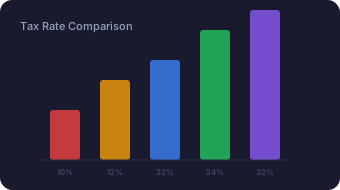
The most immediate and discernible effect of the revised Section 174 is its distortion of reported earnings and taxable income. For companies with substantial R&D investments, the transition from full expensing to five-year amortization results in a significant increase in current taxable income. This occurs because a smaller portion of their R&D outlays is deductible in the current period. Consider a tech company with $1 billion in annual R&D spending. Under the old rules, this entire amount would be deducted, reducing its taxable income by $1 billion. Under the new rules, only $200 million ($1 billion / 5 years) is deductible in the first year, increasing taxable income by $800 million compared to the prior regime. Assuming a 21% corporate tax rate, this results in an additional $168 million in federal income tax owed for that year alone.
This immediate jump in taxable income directly inflates the current tax liability, regardless of whether a company is profitable or in a growth phase. Furthermore, the accounting treatment requires companies to recognize a deferred tax asset on their balance sheets, reflecting the future tax deductions they will receive. However, this deferred asset does not offset the immediate cash outflow. Public companies are compelled to detail the impact of these changes in their SEC filings, particularly within the footnotes of their 10-K reports, where they reconcile effective tax rates and elaborate on deferred tax assets and liabilities. The increase in the cash tax burden reduces earnings available for reinvestment, share buybacks, or dividend distributions, compressing reported GAAP net income.
The Cash Flow Conundrum: Free Cash Flow Suppression
Beyond reported earnings, Section 174's amortization mandate directly attacks a company's free cash flow (FCF), a critical metric for valuation and financial health. FCF, typically calculated as operating cash flow minus capital expenditures, is fundamentally impacted by the increase in cash tax payments. The inability to fully expense R&D upfront means that more cash is diverted from operational activities to tax authorities. This is not merely an accounting entry; it represents a real outflow of capital. For example, a startup in the biopharmaceutical sector, heavily investing in drug discovery with minimal revenue, traditionally relied on immediate R&D expensing to minimize its tax burden, often delaying significant cash tax payments until profitability was well established. Now, these companies, even if cash flow negative from operations, face an accelerated tax liability from their R&D investments, exacerbating their cash burn rate.
This cash flow suppression has several ramifications. It can strain liquidity, particularly for younger, high-growth companies that operate with tighter cash reserves and depend on external funding to finance their R&D. Reduced FCF limits a company's ability to self-finance growth initiatives, forcing greater reliance on debt or equity issuance, potentially at unfavorable terms in a higher interest rate environment as observed in recent Federal Reserve bulletins. Institutional investors, who often rely on FCF models for intrinsic valuation, must now account for this structural reduction, which can diminish the perceived value of a company's underlying assets and future earnings potential. The Federal Reserve often monitors such corporate financial health metrics, and a widespread FCF squeeze across innovative sectors could signal broader economic headwinds for capital investment.
Valuation Under Duress: Discounted Cash Flow and Multiples Analysis
The diminished free cash flow stream directly translates into lower valuations using standard discounted cash flow (DCF) models. Since FCF represents the cash available to all capital providers, a sustained reduction necessitates a downward revision of future cash flow projections, thereby lowering the computed intrinsic value of a firm. Financial analysts must now build these higher cash tax payments into their projections, potentially extending the period before positive FCF is achieved or reducing the terminal value component of their models.
Furthermore, traditional valuation multiples, such as Price-to-Earnings (P/E), Enterprise Value-to-EBITDA (EV/EBITDA), and Enterprise Value-to-Sales (EV/Sales), are also impacted. While EBITDA (Earnings Before Interest, Taxes, Depreciation, and Amortization) might appear insulated as R&D is an operating expense, the effect on Net Income and Earnings Per Share (EPS) is undeniable due to the increased tax expense. For P/E multiples, reduced EPS mechanically drives up the P/E ratio, potentially making a stock appear more expensive than it would have been under prior tax law, even if the underlying operational performance remains unchanged. Some analysts attempt to "normalize" earnings by adding back the amortized portion of R&D for comparison purposes, but this adjustment is not universally applied and can introduce inconsistencies across analyses. The market’s perception of value is ultimately influenced by reported numbers, and the suppression of these figures creates a tangible valuation drag.
Sectoral Disparities: Tech and Pharmaceutical Vulnerability
The impact of Section 174's amortization is not uniform across all industries. High-growth technology and pharmaceutical sectors, characterized by their immense and sustained R&D investments, are disproportionately affected. According to various industry reports, R&D intensity (R&D as a percentage of revenue) can exceed 15-20% for established tech giants and even higher for early-stage biotech firms, sometimes comprising over 50-70% of their operating expenses. In contrast, sectors like traditional manufacturing or retail typically exhibit much lower R&D intensities.
This disparity creates a significant competitive disadvantage for U.S. innovation leaders. Companies that rely on continuous investment in new products, software development, or drug discovery now face a higher effective cost for that innovation. This can compel a re-evaluation of capital allocation strategies, potentially leading to a reduction in R&D spending, a shift of R&D activities overseas (where different amortization rules may apply, albeit with a 15-year amortization period under U.S. tax law for foreign R&D), or a greater focus on short-term, lower-risk projects over ambitious, long-cycle innovation.
Below is a comparative illustration of how Section 174's mandate could impact two hypothetical companies from different sectors, each with $100 million in pre-tax operating profit before R&D and a 21% corporate tax rate, assuming $50 million in R&D expenses for both.
| Metric / Company Type | Pre-Section 174 (Immediate Expensing) | Post-Section 174 (5-Year Amortization) | Differential Impact |
|---|---|---|---|
| Hypothetical Tech Co. (High R&D Intensity) | |||
| R&D Expense | $50 million | $10 million (amortized) | -$40 million (deduction) |
| Taxable Income | $100M - $50M = $50 million | $100M - $10M = $90 million | +$40 million |
| Cash Tax (21%) | $10.5 million | $18.9 million | +$8.4 million |
| Net Income (Illustrative) | $39.5 million | $71.1 million | +$31.6 million (before deferred tax adjustments) |
| Free Cash Flow (Illustrative) | $50M - $10.5M = $39.5 million | $50M - $18.9M = $31.1 million | -$8.4 million |
| Hypothetical Mfg Co. (Low R&D Intensity) | |||
| R&D Expense | $50 million | $10 million (amortized) | -$40 million (deduction) |
| Taxable Income | $100M - $50M = $50 million | $100M - $10M = $90 million | +$40 million |
| Cash Tax (21%) | $10.5 million | $18.9 million | +$8.4 million |
| Net Income (Illustrative) | $39.5 million | $71.1 million | +$31.6 million (before deferred tax adjustments) |
| Free Cash Flow (Illustrative) | $50M - $10.5M = $39.5 million | $50M - $18.9M = $31.1 million | -$8.4 million |
Note: While the absolute cash tax impact is the same for the same R&D spend, the proportional impact on a company's overall financials (especially cash flow relative to total revenue or operating profit) is much greater for companies where R&D forms a larger proportion of their core business strategy and expenses. For a tech company where $50M R&D is 20% of its total revenue, the FCF reduction is a larger hit to its capital structure than for a manufacturing company where $50M R&D is 5% of its much larger revenue base.
Mid-2026 Horizon: Persistent Drag and Limited Amelioration
As we approach mid-2026, the cumulative effect of Section 174's amortization will be profoundly evident. Companies that began amortizing R&D in 2022 will only have expensed 80% of their initial 2022 R&D by the end of 2025. Their 2023 R&D will be 60% expensed, 2024 R&D 40% expensed, and 2025 R&D 20% expensed. The "stacking" of unexpensed R&D from multiple years continues to suppress current deductions, ensuring the drag persists well beyond the initial implementation. This is not a short-term blip that unwinds after a year or two; it's a structural change with a multi-year recovery horizon built into the amortization schedule itself.
While some might argue that the overall lower corporate tax rate (21% compared to a top marginal rate of 35% pre-TCJA) partially offsets this, the specific impact of Section 174 is distinct. It elevates the effective tax rate for R&D-intensive firms by accelerating their tax payments, regardless of the nominal statutory rate. No significant offsetting factors are currently in play that would naturally ameliorate this specific aspect by mid-2026 without direct legislative intervention. The economic consequences include a potential chilling effect on domestic R&D investment and a possible reduction in the global competitiveness of U.S. companies that rely on innovation for growth. The continued suppression of FCF could also limit opportunities for share buybacks or dividend increases, impacting shareholder returns.
Legislative Outlook: Prospects for Relief
The severe financial implications of Section 174's amortization have not gone unnoticed by policymakers or industry groups. There has been significant bipartisan acknowledgment of the unintended negative consequences, with calls for restoring immediate R&D expensing. Numerous bills have been introduced in both the House and Senate aimed at reversing this change, often bundled with other tax provisions. The "American Innovation and Choice Online Act" and the "Tax Relief for American Families and Workers Act of 2024" are examples of legislative attempts that included a fix for Section 174.
Despite broad support from business lobbies and R&D-heavy sectors, legislative relief remains uncertain. The primary hurdle is the budgetary cost. The Congressional Budget Office (CBO) scores such a reversal as a significant revenue loss over the 10-year budget window, requiring offsetting measures or a willingness to increase the national debt. In a highly polarized political environment, finding consensus on such offsets is challenging. Furthermore, the upcoming 2024 election cycle and subsequent political dynamics by mid-2026 introduce further uncertainty. While there is a strong economic case for restoring immediate expensing to bolster U.S. innovation and competitiveness, the political will and legislative capacity to enact such a change before mid-2026 are not guaranteed. Institutional investors should therefore factor in the high probability of continued Section 174 amortization when evaluating R&D-intensive companies for the foreseeable future.
Strategic Corporate Responses and Mitigation
Companies have not been passive recipients of this tax change; they are actively strategizing to mitigate its impact. A primary response involves intensified lobbying efforts to advocate for the restoration of immediate R&D expensing. Internally, financial teams are adjusting their budgeting and forecasting models to account for the higher cash tax burden and reduced FCF. This includes revising internal hurdle rates for R&D projects and potentially prioritizing projects with faster returns or lower upfront capital intensity.
For some, especially smaller, growth-stage companies, the increased tax burden strains liquidity and could necessitate changes to their capital structure, potentially increasing reliance on debt or equity financing. The venture capital community has also taken note, scrutinizing the FCF projections of R&D-heavy startups more closely. Larger companies might consider relocating some R&D activities overseas to jurisdictions with more favorable tax treatments, although this comes with its own set of complexities and the 15-year amortization rule for foreign R&D under Section 174 still applies for U.S. tax purposes. Critically, companies are also engaging in proactive investor relations, educating shareholders and analysts on the specific impact of Section 174 and providing adjusted financial metrics that "look through" the amortization effect to present a clearer picture of underlying operational performance.
Institutional Takeaway
By mid-2026, the enduring financial impact of Section 174 R&D amortization will continue to exert a material and predictable drag on corporate valuations, particularly within the U.S. technology and pharmaceutical sectors. The initial shock of increased cash tax payments and suppressed free cash flow has matured into a persistent operational reality, necessitating a recalibration of investment theses. The stacking effect of annual R&D amortization means that the full pre-TCJA benefit will not naturally re-emerge for any given year's R&D expenditure until five years post-incurrence, creating a continuous headwind.
For institutional investors, several actionable points emerge:
1. Refined Valuation Models: It is imperative to incorporate the higher effective tax rates and reduced free cash flows directly into DCF models and to cautiously apply valuation multiples, potentially adjusting for the R&D amortization impact.
2. Sector-Specific Vigilance: Maintain acute awareness of the disproportionate impact on R&D-intensive sectors. Companies in these areas may exhibit lower reported earnings and FCF, requiring a deeper analytical dive beyond headline numbers.
3. Legislative Monitoring: Actively track congressional initiatives and political developments related to Section 174. While bipartisan support exists, the path to legislative relief remains uncertain and highly dependent on broader fiscal policy negotiations.
4. Management Engagement: Engage with company management on their strategies to mitigate Section 174's impact, including internal capital allocation, tax planning, and investor communication regarding adjusted financial performance metrics.
5. Comparative Analysis: When evaluating U.S.-based R&D-intensive companies, consider how their valuation might compare to international peers operating under more favorable tax regimes, potentially revealing a competitive disadvantage for the former.
The mandatory amortization of R&D expenditures is a structural tax change, not a temporary anomaly. Its continued suppression of reported earnings and cash flows for America's most innovative companies underscores a critical challenge to U.S. competitiveness and warrants sustained attention from institutional capital allocators.
Disclosure: WealthGrid Hub is an independent research publisher. This analysis is for educational and quantitative modeling utility only. It does not constitute specific investment, legal, or tax advice.